He Called Her Pain Fake Until The Hospital Evidence Spoke Out
The elevator doors opened before I was ready.
Mark stepped out in his navy office suit.
His tie was straight.
His jaw was locked.
His eyes went straight to the room where our daughter was hiding.
Two security guards moved into the hall.
The first guard put himself between Mark and Hailey’s door.
The second guard raised one palm.
“Sir, you cannot enter this room.”
Mark gave the kind of laugh he used at home.
“That is my daughter,” he said.
Then he pointed at me.
“My wife is confused.”
Behind the door, Hailey made a sound I had never heard before.
It was not a sob.
It was the sound of a child trying to disappear.
I had heard her laugh through walls for years.
Then, little by little, my daughter vanished inside her clothes.
She wore oversized hoodies in warm rooms.
She stopped eating breakfast.
She stopped begging for rides to practice.
She flinched when Mark walked into the kitchen.
I noticed.
I asked.
I failed anyway.
Mark always answered first.
“Teenage drama,” he said.
“She wants attention.”
“Girls that age lie.”
The lock came next.
Mark bought it after he claimed Hailey had been sneaking out.
I never saw proof.
I only saw the new metal plate on her bedroom door.
He said it was for safety.
The night everything changed, I found Hailey on the floor beside her bed.
Her arms were wrapped around her stomach.
Her pillow was wet.
Her face had gone gray.
“Mom,” she whispered, “please make it stop.”
I reached for my phone.
She grabbed my wrist.
“Don’t tell Mark.”
That fear did what her pain had not done yet.
It broke through me.
The next morning, I packed a hospital bag under the laundry room sink.
I put in her hoodie, socks, charger, insurance card, and camera bag.
I did not know why she begged for the camera bag.
I only knew she held it like a life jacket.
When I reached for the bank card, Mark saw me.
We were standing outside Hailey’s bedroom.
The new lock was between us like a warning.
He took the card from my hand.
“Waste one dollar on a doctor,” he said, “and don’t come home.”
For a second, I felt the old reflex.
Explain.
Apologize.
Wait for a better time.
Then Hailey made a tiny sound behind the door.
I looked at Mark and said nothing.
I waited until he left for work.
Then I opened that bedroom door with the spare key I had hidden.
Hailey was sitting on the edge of the bed.
The camera bag was already in her lap.
“Are we going?” she asked.
Her voice sounded older than mine.
I drove to St. Helena Medical Center with both hands locked on the wheel.
Hailey watched the passing streets without blinking.
She did not ask where Mark was.
She did not ask if he knew.
That silence told me more than words.
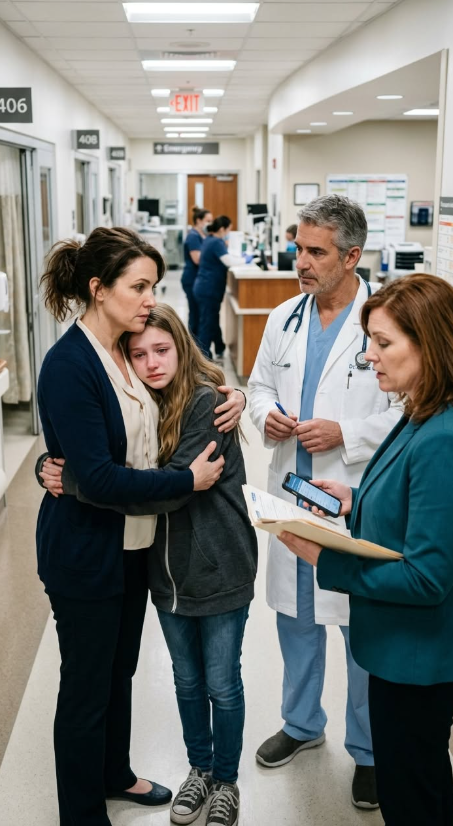
At triage, the nurse looked at Hailey and stopped smiling.
Then came the ultrasound.
The technician moved the wand across Hailey’s stomach.
She said she needed the doctor.
She left the room too quickly.
I sat beside my daughter and held her sleeve.
“It’s bad, isn’t it?” Hailey asked.
I wanted to lie.
I could not.
“Whatever it is, we stay together.”
Dr. Adler came in twenty minutes later.
He carried a folder against his chest.
A woman in a teal blazer followed him.
She introduced herself as Denise, the hospital social worker.
She closed the door.
That small click sounded final.
“Mrs. Carter,” Dr. Adler said, “the scan shows your daughter is pregnant.”
The room did not spin.
It narrowed.
It became my daughter’s face.
Hailey covered her mouth with both hands.
She did not look surprised.
That was the part that split me open.
“She is fifteen,” I said.
The doctor nodded once.
His eyes stayed kind.
Denise crouched beside the bed.
“Hailey, you are not in trouble.”
Hailey shook so hard the paper under her crackled.
“No one here is angry with you,” Denise said.
My daughter looked at me then.
Her eyes were huge.
“He said nobody would believe me.”
I stopped breathing.
Denise did not ask who “he” was right away.
She asked a safer question.
“Who has access to your room at night?”
Hailey pressed her lips together.
I answered without meaning to.
“Mark.”
Denise looked at me.
Not shocked.
Ready.
That was worse.
The lock was never love; it was evidence.
Dr. Adler sealed the scan report inside a hospital evidence folder.
Denise asked if Mark was Hailey’s legal parent.
I said yes.
She asked if he should be allowed into the room.
Hailey shook her head before I could speak.
A nurse removed Mark from the visitor list.
Security was called.
The hospital room changed around us.
It became a protected space.
I had never seen protection move so quietly.
Then my phone buzzed.
MARK: I know where you are.
The next message arrived instantly.
MARK: Bring her outside. Now.
I showed Denise.
She read both messages and did not touch the phone with bare hands.
“Family location app?” she asked.
I nodded.
Mark had installed it after saying families needed transparency.
He had used it to find us.
He had no idea it would find him too.
The elevator opened before the detective arrived.
Mark walked out.
He looked clean, polished, furious.
He looked like a man interrupted during something he owned.
Security stopped him ten feet from Hailey’s door.
He raised his voice.
I had heard that voice through bedroom walls.
Now everyone heard it.
“Claire, open that door.”
I stood in the doorway.
My legs shook.
My voice did not.
“No.”
Mark’s eyes flicked over my shoulder.
“Hailey, come out here.”
Hailey made herself smaller behind me.
Denise stepped forward.
“Sir, your access has been restricted.”
Mark smiled at her.
It was the smile he used on bank managers.
“My wife is emotional.”
Denise held the folder against her chest.
“Your wife brought your daughter for medical care.”
“For attention,” he said.
Dr. Adler’s face changed.
It was only a small tightening around the mouth.
But I saw it.
So did Mark.
“You have no right to keep me from my child,” Mark said.
Denise said, “The hospital has that right today.”
Mark looked at me then.
His face dropped its public mask.
“You will regret this.”
For once, the threat landed in front of witnesses.
That mattered.
Hailey tugged my sleeve.
“Mom.”
Her camera bag was on the chair beside the bed.
She pointed at it with two fingers.
“The phone.”
I did not understand.
She whispered the password.
I took the bag to Denise.
Inside, wrapped in a gray sweatshirt, was an old phone.
The screen was cracked at the top.
The case had a faded sticker from a soccer tournament.
Denise put on gloves.
She entered the password.
There were six audio files.
Each file had a date.
Each file had a time.
Denise looked at Hailey.
“Do I have your permission to play one?”
Hailey nodded once.
Mark was still arguing in the hall.
The first recording began with a door hinge.
Then came Mark’s voice.
“Stay quiet.”
Hailey made a wounded sound beside me.
The recording continued.
“No doctor will ever know.”
No one in the hallway moved.
Mark stopped talking.
His face went pale so fast it looked physical.
He reached for the phone.
The security guard caught his wrist before he touched Denise.
“Do not do that,” the guard said.
Mark pulled back.
His voice came out smaller.
“She made that.”
Denise did not argue.
She handed the phone to the nurse, who placed it into a clear evidence bag.
The bag was sealed.
The folder was sealed.
The messages on my phone were photographed.
For the first time, Mark’s words did not vanish after he said them.
They stayed.
They had labels.
They had time stamps.
They had witnesses.
The detective arrived seventeen minutes later.
His name was Alvarez.
He spoke to Hailey with the door open and me beside her.
He never asked why she waited.
He never asked why she did not scream.
He asked what she needed to feel safe.
Hailey looked at the hallway.
“I don’t want him near me.”
Detective Alvarez wrote that down.
Mark heard it.
His face twisted.
“You turned her against me,” he said to me.
I thought I would feel rage.
I felt something colder.
I felt awake.
Dr. Adler ordered more tests.
Denise arranged a private room on another floor.
Security moved with us.
Mark was told to leave the hospital.
He refused.
That refusal became another report.
He shouted.
That became another witness statement.
He tried to call Hailey’s phone.
That became another screen shot.
By sunset, Mark had done more to prove the truth than I had.
He had always counted on closed doors.
The hospital kept opening them.
That night, Hailey slept for three straight hours.
I sat beside her bed and watched the monitor blink.
Denise brought me vending machine crackers.
I could not eat them.
She sat down anyway.
“You are going to blame yourself,” she said.
I looked at Hailey.
“I already do.”
Denise’s voice stayed gentle.
“Then blame yourself later.”
I looked at her.
“Tonight, help us keep her safe.”
So I did.
I signed the protective paperwork.
I gave consent for the evidence transfer.
I called my sister Mara, the one Mark said was too dramatic.
Mara arrived with a duffel bag and no questions.
She took one look at Hailey and cried silently.
Then she stood guard outside the bathroom door while Hailey washed her face.
Small protections became holy that night.
A clean sweatshirt.
A locked hospital wing.
A nurse who knocked before entering.
A phone Mark could not touch.
At midnight, Detective Alvarez returned.
He had a printout in his hand.
He asked about the family location app.
Mark had turned on location sharing for all three of us.
He had said it was for emergencies.
The app kept a history.
It showed my evening shifts.
It showed Hailey’s school route.
It showed Mark’s phone stopping outside Hailey’s bedroom many nights.
The times matched the recordings.
I stared at the pages.
Every dot felt like a nail in a door.
Alvarez turned one page around.
“He used the app to find you here.”
I nodded.
“That may help us prove he knew exactly where she was.”
The final twist was so cruel I almost laughed.
Mark had built the cage with a tracker.
Then he stepped into its record himself.
The legal process did not move like a movie.
It moved like paperwork.
Slow.
Careful.
Heavy.
But it moved.
A protective order came first.
Then interviews.
Then lab work.
Then charges.
I will not write the details that belong only to my daughter.
Some truths are not for strangers to consume.
What matters is that she was believed.
What matters is that doors opened.
What matters is that Mark’s voice followed him into rooms where charm did not work.
He tried to say the recordings were edited.
The phone data disagreed.
He tried to say Hailey was unstable.
The doctors disagreed.
He tried to say I was vindictive.
The location history disagreed.
Every tool he used to control us became a witness against him.
Months later, Hailey stood in a courtroom hallway with her camera around her neck.
She held my hand until her name was called.
Then she let go.
When she came out, she was shaking.
But she was standing.
Hailey asked me later if I hated Mark.
I told her the truth.
“Yes.”
She nodded.
Then she asked if that made her bad.
I turned toward her fully.
“No, sweetheart.”
She looked down at her camera.
“Sometimes I miss who I thought he was.”
That sentence hurt more than any scream.
I said, “I do too.”
We sat in the car for a long time.
Neither of us pretended healing was simple.
Spring came slowly.
Hailey started taking pictures again.
Not people at first.
Doorways.
Windows.
Empty soccer fields.
The hospital bracelet in a drawer.
Then one morning, she took a picture of Mara laughing at our kitchen table.
The sound startled both of us.
Hailey looked at the photo and smiled.
It was small.
It was hers.
The old bedroom lock is gone now.
Mara’s husband removed it with a screwdriver and shaking hands.
He asked what I wanted done with it.
I said to throw it away.
Hailey stopped him.
She took one picture first.
The lock sat on the porch rail in bright daylight.
It looked cheap.
It looked ordinary.
It looked nothing like the power Mark gave it.
That was the point.
Hailey printed the photo later.
She wrote one word under it.
Evidence.
I keep that picture in a folder with the court papers.
Not because I need to remember Mark.
I keep it because I need to remember the day my daughter was believed.
I need to remember the nurse who asked twice.
I need to remember the doctor who closed the folder carefully.
I need to remember the social worker who did not flinch.
I need to remember the guard who put his body between Mark and the door.
Most of all, I need to remember Hailey’s hand opening that camera bag.
She saved herself before I knew how to save her.
I only drove the car.
I only opened the door.
But sometimes that is the first rescue.
You open the door.
You believe the child.
You keep going when the person blocking you says not to come home.
Hailey is home now.
Not the old home.
A smaller apartment with too many plants.
A kitchen where nobody answers for her.
A hallway with no locks on bedroom doors.
Some nights are still hard.
Some mornings are beautiful anyway.
Last week, she left a photo on my pillow.
It was the hospital corridor.
She had gone back with Denise for a support meeting.
In the picture, sunlight fell across the floor.
The elevator doors were closed.
The hallway was empty.
On the back, Hailey had written four words.
He cannot come in.
I sat on my bed and cried until the paper blurred.
Then I put that photo beside the picture of the lock.
One showed the thing that trapped her.
One showed the place that freed her.
Both were true.
But only one still had power.
