My Parents Gave My Sister the Home I Had Paid For—Then Tried to Steal My Lake House Until One Old Key Became Evidence
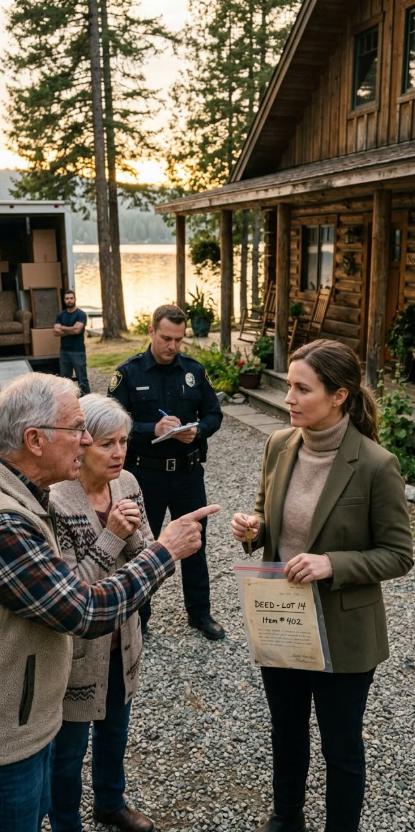
The police officer replayed the video.
No one spoke.
The sound of my father’s voice echoed across the quiet lakeside yard.
“Once we get our furniture inside, Ruby won’t have the nerve to throw us out.”
The recording ended.
The officer lowered my phone.
He looked at my parents.
“Is that your voice, sir?”
My father hesitated.
It was taken out of context.”
“What context would make that statement lawful?”
He didn’t answer.
My mother stepped forward.
“This is a family misunderstanding.”
The officer shook his head.
“No, ma’am.”
“It’s a trespassing investigation.”
The movers exchanged uneasy glances.
One of them quietly set down the box he was carrying.
“We were told this was their cabin,” he said.
I looked at him.
“They told you they owned it?”
“They said they were moving into their retirement home.”
The officer wrote another note.
“Did either of them mention the property belonged to someone else?”
The mover slowly shook his head.
“No.”
My father’s confidence was beginning to disappear.
He pointed toward the brass key inside the evidence bag.
“We had a key.”
The officer held it up.
“A key isn’t ownership.”
He looked directly at my father.
“And according to the homeowner, your permission to enter had already been revoked.”
My mother folded her arms.
“She gave us that key years ago.”
“I also sent you a written notice telling you not to use it.”
The officer turned toward me.
“Do you have that message?”
“I do.”
I opened my phone again.
The group text appeared exactly as I remembered it.
You do not have permission to enter or stay at my lake house. Do not go onto the property.
Below it sat my mother’s reply.
You’re overreacting.
Then my father’s.
We’ll discuss it later.
Neither denied receiving the message.
The officer read both.
He nodded.
“That makes the situation very clear.”
My father grew louder.
“She’s our daughter.”
“And this is her property.”
The officer’s tone never changed.
“Those two facts can exist at the same time.”
Another patrol car arrived.
A second officer stepped out carrying a small notebook.
After a brief conversation, he approached the movers.
“We’ll need statements from each of you.”
The older mover sighed.
“I figured something wasn’t right.”
“What made you think that?”
He pointed toward the truck.
“The clients kept arguing about whether the owner would ‘give in once they were settled.’”
My stomach tightened.
So that had been the plan all along.
Move in.
Fill the cabin.
Count on guilt to do the rest.
My mother looked at me.
“We’re your parents.”
“I know.”
“You’d really have us arrested?”
“I asked you not to come.”
“You chose to ignore me.”
She pressed a hand dramatically against her chest.
“This is what we’ve sacrificed for?”
I almost laughed.
Sacrificed.
Five years earlier, I had been the one working weekends.
The one skipping vacations.
The one paying invoices before paying myself.
Every month, I had transferred money without complaint because I believed I was saving our family home.
I remembered the winter the furnace failed.
Dad had called me sounding exhausted.
“We’re in trouble.”
I paid the repair bill before sunrise.
When the roof leaked after a spring storm, I canceled a long-awaited anniversary trip with Ethan to cover the contractor.
Every emergency somehow became mine.
Every celebration somehow became Vanessa’s.
The cabin had been different.
Every board on the porch had been stained by my own hands.
I had planted the lavender beside the front steps.
I had built the small bookshelf in the living room with Ethan one rainy weekend.
No one had given me that place.
I had earned it.
The officer interrupted my thoughts.
“Miss Miller, would you like these individuals formally removed from your property?”
I looked at my parents.
At the moving truck.
At the furniture already sitting in the gravel.
Then I answered quietly.
“Yes.”
The officers instructed everyone to begin loading the belongings back onto the truck.
My father refused.
“I’m not touching anything.”
One officer looked at the movers.
“Please reload the items.”
The company supervisor nodded.
“We’ll take care of it.”
Within an hour, every piece of furniture had been returned to the truck.
My mother’s favorite armchair disappeared first.
Then the dining table.
Then the stack of carefully labeled boxes.
She watched in silence.
The reality was finally settling in.
The cabin had never been hers.
Neither had the right to demand it.
Before leaving, the officer returned to me.
“The district attorney will decide whether to pursue charges.”
He handed me a case number.
“In the meantime, consider changing every exterior lock.”
“I already scheduled it.”
He smiled faintly.
“Good.”
After everyone left, I walked through the cabin.
Nothing had been stolen.
The rooms smelled of cedar and fresh paint.
The lavender outside the porch swayed gently in the afternoon breeze.
For the first time in years, I allowed myself to cry.
Not because of the attempted break-in.
Because I finally accepted something I had spent years refusing to believe.
No amount of generosity would ever satisfy people who viewed kindness as entitlement.
The following week, I met with an attorney.
She reviewed five years of bank transfers.
Mortgage payments.
Property tax receipts.
Insurance records.
Home repair invoices.
Every payment I had made toward my parents’ house.
She looked up from the file.
“Did they ever sign a repayment agreement?”
“No.”
“Did they ever promise ownership?”
“No.”
She nodded thoughtfully.
“Then recovering those funds may be difficult.”
I expected that answer.
Money wasn’t the reason I had come.
“I want to make sure they never claim my cabin again.”
She smiled.
“That part is much easier.”
Together, we updated my estate plan, confirmed every property record, and formally revoked all previous emergency access authorizations.
A cease-and-desist letter followed.
It wasn’t dramatic.
It was precise.
Any future entry onto the property without permission would result in immediate legal action.
The message was received.
Months passed.
No one came back.
Vanessa sent one email accusing me of destroying the family.
I didn’t respond.
My parents left two voicemails.
Neither contained an apology.
Only complaints about how embarrassed they had been.
I deleted them.
The first holiday without them felt strange.
Quiet.
Peaceful.
Ethan and I spent Thanksgiving at the cabin.
We cooked too much food.
Burned the first pie.
Laughed about it anyway.
That evening, sitting on the porch with blankets wrapped around our shoulders, he asked the question I’d been avoiding.
“Do you miss them?”
I thought for a long moment.
“I miss the family I believed I had.”
He nodded.
“I understand.”
A year later, I finally took the trip to Italy I had postponed so many years before.
Walking through Florence, I realized something unexpected.
I wasn’t thinking about the money.
Or the house.
Or even the wedding where my parents had proudly handed my sister the deed I had quietly helped save.
I was thinking about freedom.
The freedom that arrived the moment I stopped confusing obligation with love.
When I returned home, the lavender around the cabin was in full bloom.
The locks had been changed.
The security cameras quietly watched every entrance.
Inside, everything remained exactly where I had left it.
Safe.
Peaceful.
Mine.
Sometimes people asked whether I regretted helping my parents all those years.
I always answered the same way.
“No.”
“I regret believing that love had to be purchased.”
The old brass key that my father once believed guaranteed him another free home never opened my door again.
Instead, it rested in a police evidence file—a small piece of tarnished metal that proved something far more valuable than ownership.
It proved that setting boundaries isn’t betrayal.
Sometimes it’s the first honest act of love you ever show yourself.
